
Small Business Cyber Security Plan for Arizona Offices Today

Every Arizona small business should have a clear, practical plan to reduce cyber risk without adding complexity or cost. Start with simple, prioritized steps that protect your data, your customers, and your ability to operate. small business cyber security plan is more than a checklist, it is a working process you update and test regularly.
Small Business Cyber Security Plan & Managed IT Services in Arizona
Why a focused cyber security plan matters for Lake Havasu City, Tempe and Phoenix businesses
Here’s the thing, cybercriminals do not target companies because they are large, they target them because they are vulnerable. Recent industry reporting shows small businesses are frequent targets and many lack formal incident response plans. That means a compromise can quickly become an existential threat for a local office, clinic, retail shop, or dealership.
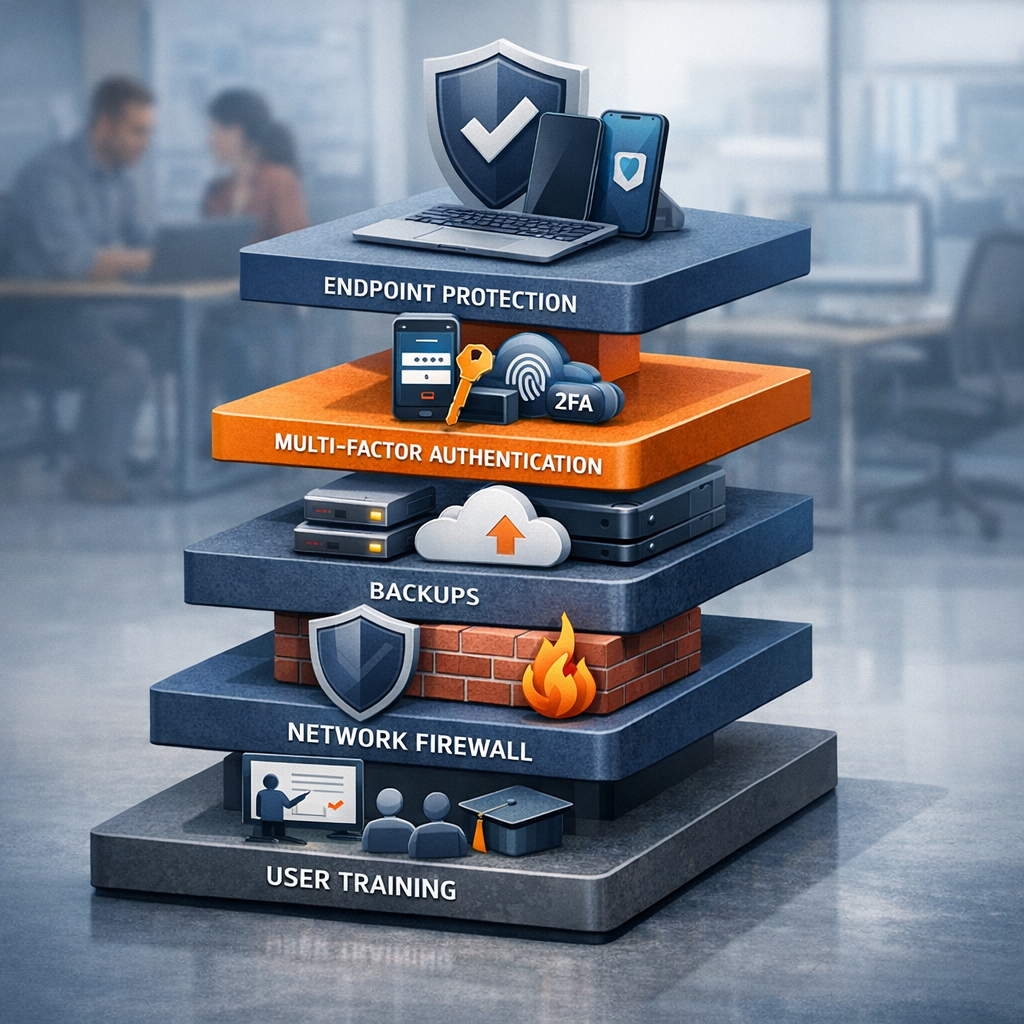
Core components of a practical small business cyber security plan
1) Risk assessment and inventory
- Map your critical assets: customer records, financial systems, POS devices, and protected health information if you serve healthcare/dental.
- Identify high-risk entry points: remote access, old servers, unmanaged WiFi, printers and copiers.
- Prioritize fixes by business impact and ease of remediation.
2) Endpoint protection and patch management
- Deploy reputable endpoint protection on every PC and server, and enable automatic OS and application patching.
- Enforce disk encryption for laptops and mobile devices used by staff working from home or on the road.
3) Multi-factor authentication and password hygiene
- Require multi-factor authentication for admin accounts, cloud services, and remote access.
- Use company-wide password managers and enforce strong, unique passwords.
4) Network segmentation and firewall rules
- Segment guest WiFi from internal networks so a compromised device on guest WiFi cannot reach business systems.
- Use business-class firewalls with intrusion detection and logging. NSSAZ can design and manage these controls for local Arizona offices.
5) Reliable backups and tested recovery plans
- Implement automated, immutable backups with offsite or cloud copies.
- Test full-system recoveries quarterly so you know how long restoration will actually take during an incident.
- Consider managed Business Continuity & Disaster Recovery (BCDR) options to reduce downtime.
6) Employee training and phishing defenses
- Regular short training sessions stop most phishing attacks.
- Run simulated phishing exercises and follow up with targeted coaching for employees who click.
7) Incident response playbook
- Document who does what when a breach happens, including who to notify and how to isolate affected systems.
- Keep contact details for your MSP and legal, insurance, and public relations partners ready.
8) Vendor and compliance management
- Maintain an inventory of third-party services and ensure they meet your security requirements.
- For regulated industries, map controls to HIPAA, PCI, or other applicable standards and document compliance steps.
How an Arizona MSP helps you turn a plan into measurable security
- Managed services provide 24/7 monitoring, patching, and endpoint control so you can focus on running the business.
- Local, responsive support matters. NSSAZ provides on-site and remote help from offices in Lake Havasu City and Tempe/Phoenix, so you talk to an engineer who knows your environment.
- For phone and communications protection, integrate secure business VoIP solutions that include call encryption and central management. Learn more about our business VoIP phone systems.
Quick checklist: 30-60-90 day plan
- 30 days: Inventory assets, enable MFA on critical accounts, deploy endpoint AV.
- 60 days: Implement automated patching, configure backups and test restore of one system, run a phishing test.
- 90 days: Review firewall rules, segment networks where needed, finalize incident response playbook and schedule tabletop exercise.
Common objections and straightforward responses
- "We are too small to be targeted." Many attackers prefer small targets with weaker defenses. A basic plan prevents the most common attacks and is cost-effective.
- "It will slow productivity." Good security should be mostly invisible, and managed solutions reduce user friction while improving defenses.
- "We can’t afford a full-time security team." That is exactly where a local MSP with managed IT and BCDR services provides value and predictable budgeting.
Local considerations: Arizona-specific risks and recommendations
- Practice continuity for seasonal staffing changes common in Lake Havasu City and Phoenix offices. Ensure temporary staff receive security onboarding.
- Retail and dealership locations should pair secure POS practices with video surveillance and managed copy & print services to reduce physical and digital risk. See video surveillance solutions and managed copy & print services for business-grade options.
Helpful resources and further reading
- Cybersecurity trends and small business risk studies, such as industry reporting by major business outlets, highlight the rising frequency of attacks on SMBs.
Ready to protect your business? (next steps)
If you want a straightforward, prioritized cyber security plan for your Arizona office, request a free IT consultation with Network Systems & Solutions. We combine managed IT, network security, backups, and communications so you have one vendor responsible for outcomes. Contact us at https://nssaz.com/contact-us/, call Lake Havasu: (928) 855-9088, or Tempe/Phoenix: (480) 569-6897.
Frequently asked questions
What is the minimum I need to get started with a cyber security plan?
Begin with discovery and asset inventory, enable MFA and endpoint protection, and put automated backups in place. These steps stop most common attack paths.
How often should a small business test backups and recovery?
Quarterly full restores are a strong best practice. Testing validates both the backups and the team’s ability to recover quickly.
Can NSSAZ help my clinic meet HIPAA security requirements?
Yes, NSSAZ offers compliance consulting and managed IT services to help healthcare and dental practices build and document required controls.
Do I need cyber insurance if I have strong defenses?
Cyber insurance helps with incident costs, but insurers want to see solid technical controls in place. A documented security plan improves insurability and reduces premiums.
How long does it take to implement a basic cyber security plan?
Most small businesses see meaningful improvement in 30 to 90 days for core controls. Full maturity is continuous and evolves with business needs.
What role does employee training play in security?
Employee behavior is the top risk. Short, regular training plus phishing simulations reduce successful attacks substantially.
How much does a managed plan cost?
Costs vary by business size, risk profile, and services chosen. NSSAZ can provide a clear proposal aligned to your budget and risk tolerance.
Conclusion
A practical small business cyber security plan for Arizona offices is achievable, affordable, and measurable. Start with the basics, work with a trusted local MSP, and treat security as an ongoing business process. NSSAZ brings decades of experience and local responsiveness to help you protect data, reduce downtime, and stay compliant.
If you are ready to build a prioritized plan for your Lake Havasu City, Tempe or Phoenix office, request a free IT consultation or schedule a network and security review today at https://nssaz.com/contact-us/.